
The PaliBu Voice
NEWS • BUSINESS • COMMUNITY • RECOVERY
September 2026
The PaliBu Voice: Recovery Is About Showing Up, Connecting and Moving Forward
There is a lot happening across Pacific Palisades and Malibu right now—and that matters.
Recovery is not one project or one decision. It is homeowners figuring out how to finance a rebuild. Businesses finding their footing. Families learning how to build back more resiliently. Employers looking for workers. Residents navigating insurance. And a growing network of businesses, agencies, nonprofits and experts stepping forward with resources and solutions.
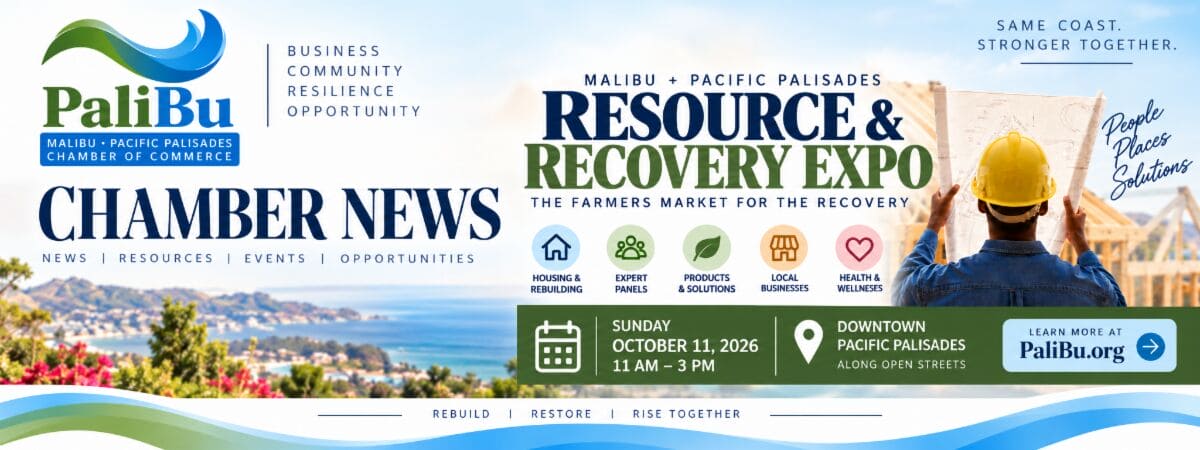
On Sunday, October 11, the PaliBu Resource & Recovery Expo returns to downtown Pacific Palisades—and this one is shaping up to be our biggest yet.
We’ve started calling it “the farmers market for the recovery,” because that is exactly what we want it to feel like: a place where you can walk down the street, talk directly to the people doing the work, see what is available, compare options, ask questions and find solutions.
More than 150 businesses, agencies, nonprofits and experts are expected to come together along La Cruz Drive and Swarthmore Avenue, bringing resources for rebuilding, architecture, construction, financing, wildfire resilience, home technology, government assistance, business recovery and much more.
If you are rebuilding a home, reopening a business, exploring financing, looking for resilience solutions—or simply trying to figure out what comes next—this Expo is for you.
Sunday, October 11, 2026 | 11 AM–3 PM
Downtown Pacific Palisades | La Cruz Drive & Swarthmore Avenue
Learn More About the PaliBu Resource & Recovery Expo
Perhaps the best illustration of all this activity will be visible on the streets of Pacific Palisades at the Expo.
1st Choice Design and Development • Ace Building Materials • Addition Building & Design, Inc. • AG Millworks • Agoura Sash and Door • All American Generators • All Weather Architectural Aluminum • ANDERSON Construction, Inc. • APB Metal Framing Solutions • Arri / LeCron Architects • Artecnica, LLC • Arzuman Brothers Inc. • Athens Services • Best Metal Roofing & Gutters • Builders FirstSource • Builders Workshop • CASABLANCA Window & Door • Cali Energy • Calstate Fire Defense • Capstone Fire & Safety Management • City of Malibu • Conejo Hardwoods • Coogan Developments • Cosmic Buildings • LA County Third District Supervisor Lindsey Horvath • Crest Real Estate / Case Study 2.0 • Dreamcatcher Homes • Drexel Luxury Homes • Ehud Zadok • Elite Generators • Ember Pro • Embers Protection Services • Empire Group Design Build • Everest Construct • F2F Sevan • Fleetwood Windows & Doors • Form Found Design • Frantz Construction • Frontline Wildfire Defense • GIBBS ARCHITECTS • Good Life Home Design Inc. • Green Future HVAC • Habitat for Humanity of Greater Los Angeles • Hainy Hydrant • hb+a Architects • IND Construction LLC • Inferno-Roll Shutters, Inc. • Just One Touch – Video & Audio Center • Koffka Phakos • LA County Assessor • LA SOLAR GROUP • Los Angeles County Public Works • Lucetti • Luxe Homecare • Luxe Windows and Doors • Metricon Homes • Multimod LLC • Network Experts, Inc. • Open Wall Systems Inc. • Palisadian-Post • Patino Design Studio • PLANK Hardwoods • Polaris Homes • Renzo Rastelli • Richard Williams Design & Construction • Rigid Design & Construction, Inc. • Rising Series by Linda Kaye • SAM HOUSE INC. • Shaner & Co. • Snyder Diamond • SoCalGas • Sorensen Architects, Inc. • SpecCeramics • Streetstudio LLC Architecture • Synergy Signature Homes • The Blooming Space • The Home Gallery • Top Termite Co. Inc. • Universal Appliance and Kitchen Center • Western Architectural Openings • westside build • Westside Remodeling • Zola Windows.SEYIE DESIGN • Noblessa Fine German Kitchens • DuPont • LA Techs • FINA Construction Group Inc • The Home Depot • SweisKloss Inc • H & H Builders and Restoration Inc • Fire Safe Malibu • Cocoturf • LT Generators Malibu Ventura LA Area • LumeraLux Solutions • Trocofab • Clear Group • Mulholland Brand
And the list continues to grow.
Come walk the streets. Ask questions. Meet the people doing the work. Discover what's possible.
Our Business Community Keeps Growing
One of the encouraging things we are seeing in this recovery is the number of businesses that want to invest their expertise, products and energy in Pacific Palisades and Malibu.
This week, we welcome new PaliBu members Cass Calder Smith Architecture + Interiors, AGMillworks, CapeGr
We are also delighted to welcome LumeraLux Solutions as a new Expo sponsor, and congratulate Addition Building & Design on upgrading its Chamber membership to Chairman’s Circle Silver.
These are more than additions to a membership roster. They represent a growing ecosystem of businesses with something tangible to contribute to the recovery.
Resources You Can Use Right Now
There are also several important opportunities coming up that we want our members and communities to know about.
--The Resilient Home Fund is now live, providing homeowners with another resource for navigating the financial side of rebuilding and creating more wildfire-resilient homes.
--Property owners should also take note of the California Residential Mitigation Program's Earthquake Multi-Unit Retrofit program. Eligible owners of 5–10 unit, multi-story residential properties may qualify for up to $49,600 toward ground-floor seismic retrofit work. Registration closes September 30.
--Wildfire resilience is also getting practical. The West Basin Municipal Water District Firescaping Workshop will help residents learn how thoughtful landscaping, plant selection, water use and defensible-space strategies can contribute to more resilient properties.
--And for homeowners navigating the financial realities of rebuilding, the California Disaster Recovery Forum on October 5 at the California Science Center will bring mortgage lenders, CalHFA, regulators and recovery professionals together to provide in-person assistance with financing, insurance, permitting and rebuilding.
Recovery Means Business Recovery, Too
PaliBu has consistently emphasized that residential and commercial recovery go hand in hand. Several upcoming programs provide important opportunities specifically for our business community.
--On September 23, LAEDC and Goodwill Southern California will host a Wildfire Recovery Business Expo & Job Fair, connecting employers, job seekers and businesses with workforce programs, hiring incentives, recovery assistance and training opportunities.
--On September 28, the Los Angeles Mayor’s Office of Business and Economic Development will host its Sports and Entertainment Procurement Summit at the Los Angeles Convention Center. With major global events—including the 2027 Super Bowl and LA28 Olympic and Paralympic Games—on the horizon, local businesses should be paying attention to the procurement and contracting opportunities these events can generate.
--And on October 21, the California Department of Insurance will hold its final Consumer Learning Series webinar of 2026, this time focused on business insurance. Small-business owners can learn more about their rights, claims and appeals, avoiding insurance scams, CDI resources and statewide programs supporting California businesses.
These may look like separate events, but together they reflect something important: recovery requires an economy that works. Businesses need customers, capital, employees, information and opportunities—and part of PaliBu's role is helping connect those dots.
And Sometimes Recovery Means Getting Out and Having Some Fun
We also have something to look forward to.
Malibu Moves race weekend is coming October 24–25, and one of our own PaliBu Board members is helping make it happen.
For anyone thinking about tackling the half marathon, the message is simple: now is the time to start training. Six weeks gives runners time for four meaningful long runs and a proper taper before race weekend.
Pick your distance. Set a goal. Walk it, run it, cheer somebody on—but come be part of it.
Remembering Together. Building Forward. 🇺🇸
As we move through mid-September, we pause to mark the 25th anniversary of September 11—remembering the lives lost, the families forever changed, and the extraordinary courage and service that emerged from tragedy. It is also a reminder of something we see every day in Malibu and Pacific Palisades: resilience is built through connection, compassion and community.
And our community is showing up.
Momentum continues to grow around the PaliBu Resource & Recovery Expo on Sunday, October 11, when 150+ businesses, agencies, nonprofits and experts will come together in the heart of Pacific Palisades. From builders, architects and designers to fire-resilience specialists, government agencies and community organizations, the Expo will create a one-stop destination for rebuilding, recovery and connection—with expert panels, resources, food, music and thousands of neighbors expected throughout the day.
There’s plenty happening beyond the Expo, too. 🌊
Our latest PaliBu Connections Breakfast brought members together for conversation, new relationships and a wonderful presentation from Board Member Erica Segel about Malibu Moves and its commitment to giving back to organizations including the Emily Shane Foundation.
We’re also excited to welcome our newest PaliBu members: Interiors with Impact, Coastal Acrylics, Inferno-Roll Shutters, Lauren Barg Real Estate, Loomeys Toys, Malibu Brigade, V’s Restaurant, Fina Construction Group, Malibu Dentistry, Multimod and Fleetwood Windows & Doors.
Coming up:
September 26 | PaliMali YMCA Back to School Bash
Food, activities and a fun day for families and neighbors.
September 26 | Malibu Safety Resource Fair
Wildfire, earthquake, flood and emergency-preparedness resources from the City of Malibu.
October 11 | PaliBu Resource & Recovery Expo
11 AM–3 PM | Swarthmore Avenue + Palisades Village
October 17 | Malibu Education Foundation Gala
Supporting all four Malibu public schools.
We’re also sharing important reminders about brush clearance and fire safety, new Malibu businesses and rebuild resources, Malibu Moves’ growing community impact, and a helpful overview of November ballot measures affecting our broader coastal business community.
Recovery happens when we stay connected, support local and keep showing up for one another.
Attend an event. Visit a local business. Welcome a new member. Share a resource. Bring a neighbor to the Expo.
Together, we keep Malibu + Pacific Palisades moving forward. 💙
#PaliBu #Malibu #PacificPalisades #RecoveryExpo #SupportLocal #Community #Rebuild #Recovery
☀️ Happy Labor Day Weekend from PaliBu!
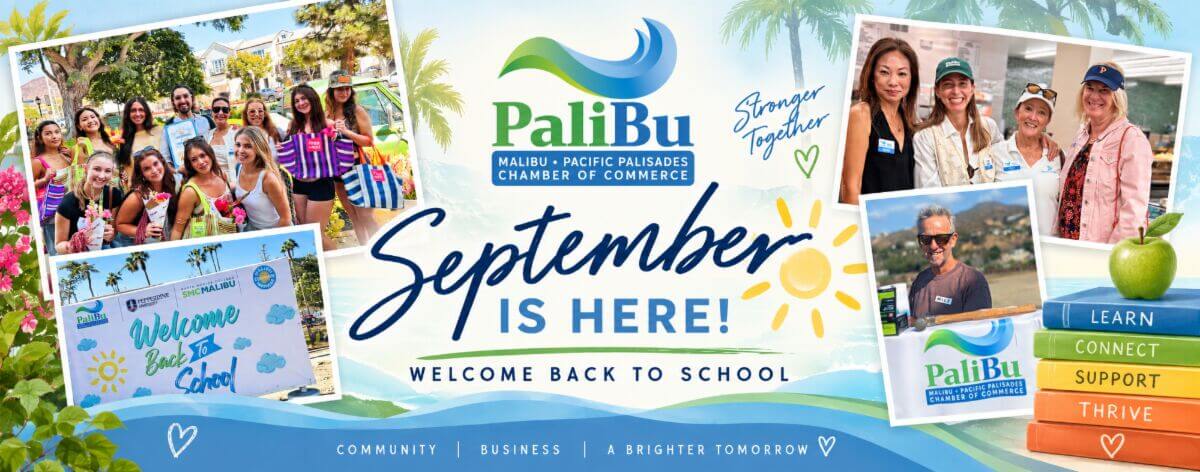
It’s been a busy few weeks across Malibu and Pacific Palisades! We’ve celebrated new store openings, welcomed new members, wished our schools a great year ahead, and continued bringing our coastal business and recovery communities together.
A warm welcome to our newest PaliBu members: Clear Group, Epoch Projects, Lights Up Today, LA Bureau of Street Services, Palisades Village Green, Rising Series by Linda Kaye, and The Kohl Team. We’re so glad to have you with us!
And there’s plenty ahead. 🌊
September 29 | PaliBu Presents: Senate District 24 Candidate Forum
Join us virtually from 7–8:30 PM for a conversation with Senate District 24 candidates Brian Goldsmith and John Erickson. Hear directly from the candidates about the issues that matter to our coastal communities and the priorities they would bring to Sacramento. Visit PaliBu.org for information and the link to join.
October 11 | Resource & Recovery Expo
150+ businesses, nonprofits, agencies, experts and resources together in one place — our “farmers market for the recovery.”
October 18 | “Know Your Customers” with Senator Ben Allen
October 24–25 | Malibu Moves at Zuma Beach
3,000 runners and their families come together for a high-energy weekend on the coast, with sponsorship, expo, corporate team and volunteer opportunities for local businesses.
For now, we’re enjoying the last stretch of a sun-kissed summer and celebrating everything that keeps Malibu + Pacific Palisades moving forward.
Happy Labor Day from PaliBu! ☀️🌊
#PaliBu #Malibu #PacificPalisades #ShopLocal #SupportLocal #Community #RecoveryExpo #MalibuMoves
August 2026
California Wildfire Legislative Package: What’s Taking Shape in Sacramento
California Wildfire Legislative Package: What’s Taking Shape in Sacramento
California lawmakers and the Governor’s office are actively working on a major wildfire legislative package—one that could have significant implications for utilities, businesses, ratepayers, insurers and, most importantly, wildfire survivors.
No final legislative language has been released, and the concepts remain very much in flux. The discussions underway, however, offer an important window into the priorities and tradeoffs shaping the package.
At the center of the debate is a difficult question: How should California distribute the enormous costs of wildfire while ensuring survivors are compensated, utilities remain financially viable, electric rates remain manageable, and communities become safer and more resilient?
The Balancing Act
Several objectives are competing for attention in Sacramento:
- Getting compensation to wildfire survivors more quickly
- Maintaining the financial stability of California utilities
- Limiting additional pressure on already-high electric rates
- Strengthening wildfire prevention, mitigation and accountability
- Stabilizing California’s insurance market and moving homeowners from the FAIR Plan back into standard coverage
How lawmakers balance those objectives will determine much of the final package.
Utility Accountability—and Who Ultimately Pays
A number of proposals focus on strengthening utility accountability.
Among the concepts under discussion are tying utility executive compensation and bonuses to safety and reliability metrics, increasing penalties and enforcement for safety violations, and potentially reducing the return on equity utilities receive for certain wildfire-mitigation investments.
The argument behind the latter is straightforward: wildfire mitigation is an essential responsibility of utilities and ultimately benefits the ratepayers who fund those investments.
The challenge is equally straightforward: even when policymakers reduce costs or returns on paper, ratepayers can ultimately bear much of the financial burden.
One ratepayer-relief concept being discussed is a climate-credit mechanism, similar to the existing cap-and-trade credit, that could help offset particularly high summer utility bills.
Getting Wildfire Survivors Paid Faster
Survivor compensation is another major focus.
One concept under consideration is a “fast pay” option that could allow utilities to compensate survivors more quickly without requiring them to accept the payment. Survivors who choose not to accept the offer would retain their ability to pursue litigation instead.
The emerging framework appears particularly focused on protecting individuals and households suffering the most direct consequences of wildfire—including death, physical injury, destruction of homes and other direct losses.
At the same time, lawmakers are examining whether some categories of non-economic damages should be modified and whether claims from large businesses and institutional interests should face different limitations.
The underlying policy question is significant: How do we preserve meaningful compensation for individual wildfire survivors while keeping the overall system financially sustainable?
Attorneys, Insurance Claims and Litigation Financing
The legal and financial machinery surrounding wildfire claims is also receiving scrutiny.
Attorney contingency fees—which can reach 30% to 40% of settlements—are part of the conversation. There is no clear solution, however, and policymakers face an obvious tension: reducing legal costs without restricting survivors’ ability to secure effective representation.
Insurance subrogation is another significant issue. Insurers seeking reimbursement for claims they have already paid have consumed a substantial portion of available wildfire funds, prompting discussion about whether those claims should be limited.
Lawmakers also appear likely to address third-party litigation financing, particularly the practice of investment and hedge funds purchasing interests in wildfire claims. The practice has attracted considerable criticism and could draw a legislative response.
The Insurance Problem Remains
One of the package’s broader ambitions is to help move Californians away from reliance on the FAIR Plan and back into the standard insurance market.
The challenge is availability.
In many fire-prone areas, insurers have substantially reduced or eliminated new coverage. Without sufficient private-market capacity, encouraging homeowners back into standard insurance remains an aspiration rather than a complete solution.
For wildfire-affected communities, the question is not simply what insurance costs. It is whether meaningful coverage will actually be available.
Paying for Wildfire Protection
Funding remains another major piece of the puzzle.
California’s Greenhouse Gas Reduction Fund, funded through cap-and-trade, was never intended to provide an indefinitely expanding source of revenue. As the emissions cap declines over time—and other demands on those revenues increase—the amount available for competing state priorities becomes increasingly constrained.
Near-term General Fund allocations have placed significant emphasis on wildfire, creating pressure on transportation, transit and other state priorities.
The broader takeaway: California's wildfire problem increasingly requires a durable funding strategy, rather than a series of temporary funding solutions.
Wildfire Will Dominate the Sacramento Agenda
The scale and complexity of the wildfire package means it is expected to consume considerable legislative attention in the coming weeks.
That has implications beyond wildfire policy. Other bills may receive less attention as lawmakers focus on the package—and, conversely, some measures could advance with less scrutiny than they otherwise might receive.
For chambers, businesses and community organizations, continued engagement in Sacramento will be important as the actual legislative language takes shape.
Chamber Advocacy Is Having an Impact
There have already been important signs that coordinated local advocacy can make a difference.
SB 1075 was held in Appropriations, following significant mobilization by local chambers.
Chambers also mobilized quickly for a recent call concerning Proposition 45, with ten chambers participating on short notice and only three voicing opposition.
These efforts underscore something we see repeatedly: Sacramento hears from organized interests every day. Local businesses and communities need to be organized, informed and present in those conversations as well.
The wildfire package is still being written. That makes now the time to understand what is being considered, identify the consequences for our communities and make sure our region has a voice in what comes next.
PaliBu will continue to follow these discussions closely and keep our members informed as specific legislative language emerges.
Disaster Recovery Requires Capital That Moves at the Speed of Business
For small businesses recovering from disaster, time matters.
A new report from the Aspen Institute, From Crisis to Continuity: Optimizing CDFI Capital and Partnerships for Natural Disaster Response, puts a national framework around something businesses in Malibu and Pacific Palisades have experienced firsthand: a business can be viable in the long term and still fail because it cannot access capital quickly enough to survive the short term.
The report notes that roughly half of small businesses have less than one month of cash reserves. After a disaster, however, expenses don’t necessarily stop when customers disappear. Businesses can continue carrying rent, payroll, insurance, inventory and other fixed costs while waiting for insurance proceeds, government assistance, loans or customers to return. (Aspen Institute)
That creates what Aspen calls a liquidity gap—and it can become the difference between temporary disruption and permanent closure.
The Role of Community Lenders
The report focuses particularly on Community Development Financial Institutions, or CDFIs, which can provide financing to businesses and communities that may not be well served by conventional lending.
Aspen identifies four financial tools that can be particularly important following a disaster:
- Payment relief for businesses with existing loans;
- Rapid-response grants, typically $5,000–$20,000, for immediate expenses;
- Rapid working-capital loans using flexible cash-flow underwriting; and
- Larger, longer-term loans to finance rebuilding, equipment and recovery. (Aspen Institute)
The important lesson is that these tools serve different needs at different stages of recovery. A $10,000 grant that arrives quickly may save a business today. A larger patient-capital loan may allow that same business to rebuild for tomorrow.
Local Knowledge + Larger Capital
Aspen also proposes a compelling “hub and spoke” model for disaster finance.
Local CDFIs and community organizations bring relationships, trust and knowledge of conditions on the ground. Larger regional and national institutions can bring capital, technology, staffing and the infrastructure necessary to process assistance at scale. (Aspen Institute)
Neither works as effectively alone.
That concept is particularly relevant as Malibu and Pacific Palisades move from emergency response into the much longer work of economic recovery.
What This Means for PaliBu
At the Malibu–Pacific Palisades Chamber of Commerce (PaliBu), we believe supporting business recovery requires more than directing businesses toward a single grant or loan program.
We are working toward a broader capital stack: bringing together CDFIs, banks, philanthropic capital, government programs and other financing partners so that businesses with different circumstances can be matched with the right type of capital.
A business trying to cover three months of operating expenses has a very different need from one rebuilding a destroyed location. A restaurant waiting for surrounding residents to return faces a different challenge from a retailer financing new inventory or a property owner rebuilding commercial space.
The financing ecosystem should recognize those differences.
Our goal is to help create a clearer bridge between capital available and capital needed—and to bring financial institutions into the recovery conversation alongside the businesses they are intended to serve.
Building the Infrastructure Before the Next Crisis
Perhaps the larger lesson of the Aspen report is that communities should not wait for the next disaster to build these relationships.
Effective disaster finance requires preparation: partnerships between local and national lenders, flexible pools of capital, operating support for CDFIs, loan-loss reserves and systems capable of moving money quickly when businesses need it most. (Aspen Institute)
For Malibu and Pacific Palisades, that work can begin now.
Our communities are rebuilding, but we are also learning. If we use this recovery to create stronger connections among businesses, lenders, government and philanthropy, we can build an economic infrastructure that is more responsive today—and considerably more resilient tomorrow.
Read the Aspen Institute report:
From Crisis to Continuity: Optimizing CDFI Capital and Partnerships for Natural Disaster Response
One Fire, Two Recoveries: Rebuilding the Malibu–Pacific Palisades Business Corridor
The Palisades Fire left the Malibu–Pacific Palisades business corridor facing two very different forms of commercial recovery.
In Malibu, most commercial buildings and businesses are standing. In Pacific Palisades, commercial buildings and entire business districts burned and must be rebuilt.
That distinction matters because the resources required for recovery are fundamentally different. One community needs greater access and economic flow. The other needs rebuilding capital. Both need sustained support.
Malibu: The Businesses Are Here. Customers Need to Reach Them.
In Malibu, the economic lifeline connecting businesses, residents and visitors is Pacific Coast Highway—and PCH has been fundamentally disrupted since the fire.
The corridor has moved through fire response, lot clearance and utility undergrounding and now into road repair and reconstruction. Portions of PCH have been reduced to one or two lanes, with 25-mile-per-hour speed limits, while the roadway itself remains vulnerable from two directions: the mountains above and the Pacific Ocean below.
For Malibu businesses, this creates an economic problem that is easy to overlook. The storefront may be standing, but that does not mean business has returned to normal.
Malibu's commercial recovery is therefore closely tied to access and economic flow.
We need to make it easier for customers to reach businesses while also recognizing the physical limitations of PCH and respecting the character of Malibu itself.
That means thinking creatively about mobility: a potential pier-to-pier ferry, a coastal trolley, better connections between commercial districts, and other ways of moving residents and visitors along the coast without simply putting more cars onto PCH.
Pacific Palisades: Rebuilding Requires Capital
Travel a few miles east and the recovery challenge changes dramatically.
In Pacific Palisades, businesses did not simply lose customers. Many lost the physical places from which they operated. Commercial properties and business districts must be reconstructed alongside the surrounding residential community.
That requires capital—and in many cases, there will not be one grant, insurance payment or conventional loan large enough to make rebuilding viable.
At the Malibu Pacific Palisades Chamber of Commerce—PaliBu—we are therefore working to bring together funders, Community Development Financial Institutions (CDFIs), lenders, philanthropic partners and public resources around what we think of as a recovery capital stack.
A rebuilding business may ultimately need a combination of grant funding, affordable financing, insurance proceeds, landlord participation, technical assistance and other resources to close the gap between the cost of returning and what the business can reasonably carry.
Our job should not be to hand a business owner a list of 25 programs and say, “Good luck.”
Our goal is to understand the actual need and help match businesses with the combination of resources that can move them forward.
Bringing Economic Activity Back to the Coast
Capital is only one side of commercial recovery. Ultimately, businesses need customers.
In Malibu, we are approaching that challenge by asking: How do we generate customers, improve access and create economic activity without overwhelming the communities we are trying to help recover?
That includes working toward stronger coastal tourism marketing and looking ahead to the LA28 Olympic and Paralympic Games as an opportunity to introduce visitors to our extraordinary coastal business corridor.
But that opportunity has to be approached thoughtfully.
By 2028, Pacific Palisades should be well into a significant rebuilding cycle, with construction sites, heavy equipment, deliveries and increasing numbers of residents returning home. Keeping roadways functioning for those essential recovery activities will be critical.
Malibu presents a different consideration. Visitors and tourists are important to its commercial areas, but much of Malibu values its rural, residential and relatively untouched character. Successful economic development must respect that identity.
The objective, therefore, isn't simply more traffic.
It is better access, thoughtful mobility and economic activity directed to the places that can benefit from it.
A Coastal Recovery Strategy
We have an extraordinary economic corridor stretching from Malibu through Pacific Palisades into Santa Monica, Venice and Marina del Rey.
Approached strategically, these communities can create new opportunities for commercial recovery, build compelling coastal experiences for visitors, support local businesses and develop better ways of moving people between destinations without placing every additional trip onto PCH.
This is where transportation, tourism and small-business recovery intersect.
A ferry or trolley is not simply a mobility project when it helps customers reach recovering businesses. Tourism marketing is not simply promotion when it helps restore revenue to a commercial district. And access to capital is not simply financing when it determines whether a longtime local business can afford to return.
Recovery Is Not One Problem
One of the most important lessons of the Palisades Fire is that economic recovery cannot be reduced to a single solution.
Sometimes the storefront is gone and the business needs capital to rebuild.
Sometimes the storefront is standing and the business needs customers to reach it.
One requires investment. The other requires access. Both require sustained attention long after the emergency phase has ended.
At PaliBu, our role is increasingly to connect those needs with solutions—to bring capital and resources into Pacific Palisades, restore customers and economic flow to Malibu, advocate for our businesses, and build partnerships that can support the entire coastal economy.
Our goal isn't simply to say that our businesses survived the fire.
It is to make sure they survive the recovery—and have the opportunity to thrive for the long term.
Maryam Zar
Savoring Summer — Supporting Shops & Restaurants
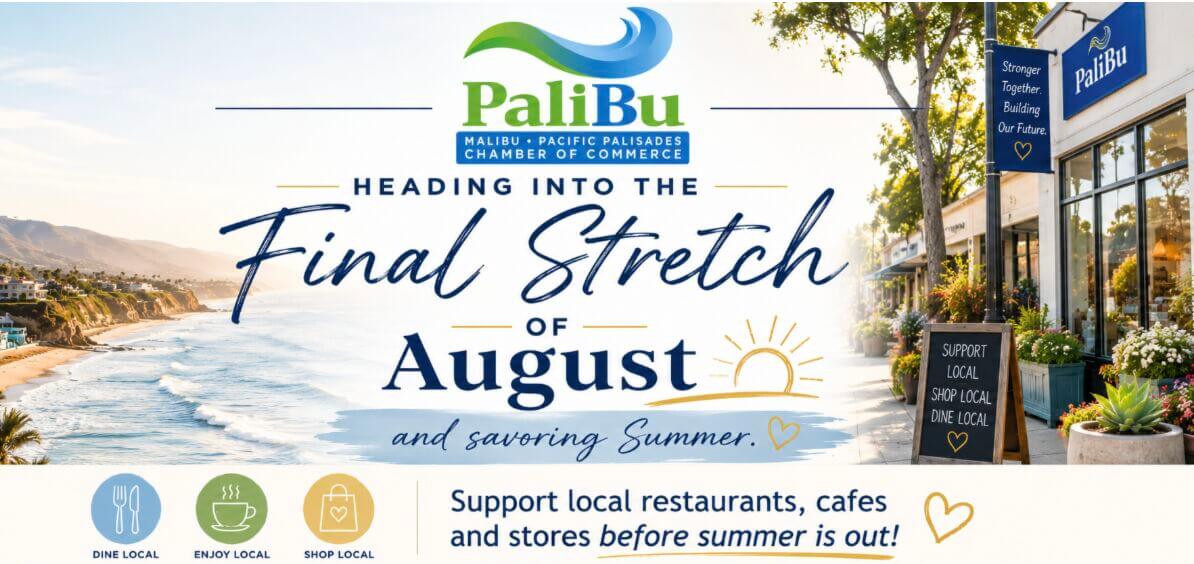
As we head into the final stretch of August, there is still plenty of summer left to enjoy—and every reason to enjoy it locally.
Across Malibu and Pacific Palisades, our restaurants, cafés, shops and small businesses remain an essential part of our recovery. They are places we gather, reconnect and restore the rhythm of community. And right now, showing up matters.
Make the reservation. Meet a friend for coffee. Try somewhere new. Stop into a shop you haven’t visited in a while. Buy the gift locally. Bring friends to Malibu or the Palisades for the afternoon.
Every visit puts dollars back into our local economy, supports local jobs and gives businesses another reason to keep investing here.
Momentum Is Building
There is real momentum to build on.
The reopening of Palisades Village has brought renewed energy and activity to the heart of Pacific Palisades. This week, we were equally thrilled to welcome back the Raw Inspiration Farmers Market, restoring another beloved community tradition and bringing residents, merchants and visitors together again.
We are also delighted to welcome a terrific group of new PaliBu members this month. Each new business joining the Chamber represents something larger than a membership: it is another vote of confidence in Malibu and Pacific Palisades and in the future of our coastal communities.
Recovery is measured in many ways. Permits, rebuilding milestones and infrastructure matter enormously. But so do busy sidewalks, full tables, open storefronts and the simple pleasure of seeing people out enjoying their community again.
An Important Recovery Milestone
At the same time, our broader recovery is reaching an important juncture.
The Los Angeles County Department of Public Health has recommended that the Board of Supervisors end the local public health emergency declared January 10, 2025, in response to the windstorm and critical fire events.
As the Board prepares to consider that recommendation, PaliBu wants our business community to understand what the change could mean—and, importantly, we want to hear from you.
What would the end of the public health emergency mean for your business or your recovery? Are there protections, programs, deadlines or other considerations you believe should be addressed before the Board acts?
Please email us with your thoughts. The Chamber’s role is not simply to report what is happening, but to make sure the experiences and needs of our businesses are represented as recovery decisions are made.
Keeping PaliBu Front and Center
That advocacy continues well beyond any single issue.
We are strengthening regional alliances, pursuing targeted outreach and creating opportunities for direct conversations with decision-makers and institutional partners. From economic recovery and tourism to rebuilding, access to capital and the return of customers and visitors, our goal is straightforward: to ensure Malibu and Pacific Palisades businesses are front and center in the conversations shaping the region’s recovery and future.
And there is a story here worth telling.
From Pacific Palisades to Malibu, the energy is returning. Our distinctive coastal character—refined, relaxed, independent and unmistakably local—is reemerging. Businesses are opening their doors, investing, rebuilding and betting on these communities.
As August winds down, let’s meet that confidence with our own.
Eat out. Linger over coffee. Browse the shops. Visit the farmers market. Try somewhere new. Bring a friend. Support the businesses that are helping bring our communities back.
There is still plenty of summer left to savor. Let’s savor it locally.
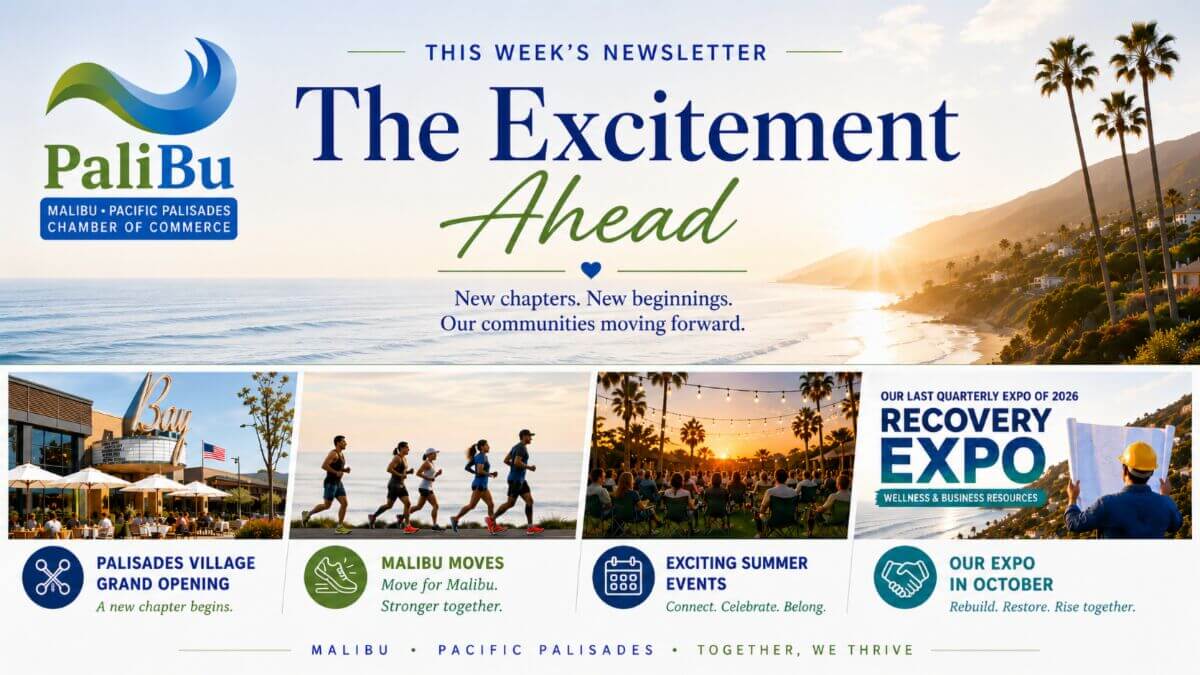
The Excitement Ahead
There is a new energy taking hold across Malibu and Pacific Palisades—and increasingly, there is a lot to celebrate.
This August brings several important signs of progress. We are welcoming new members to the PaliBu family, looking ahead to the much-anticipated Grand Reopening of Palisades Village on August 15, and preparing to welcome back the Pacific Palisades Farmers Market on August 19. New stores, restaurants, and businesses are opening their doors, our Connections Breakfasts continue bringing business and civic leaders together, and a growing calendar of events is giving our communities more reasons to gather, connect, and come back.
At the same time, important conversations about the future of our communities are gaining momentum. From thoughtful approaches to rebuilding and economic recovery to transportation solutions that could improve safety and mobility along PCH, there is a growing willingness to explore new ideas and build partnerships around them.
Among those ideas is a limited-capacity ferry concept for the Malibu coastline, now supported by Senator Ben Allen, Assemblymember Jacqui Irwin, Supervisor Lindsey Horvath, and the Calabasas, Malibu, and Santa Monica Chambers of Commerce. It is one example of the kind of regional collaboration and creative thinking that can help address long-standing challenges while supporting recovery.
There is still much work ahead. Recovery is neither quick nor linear, and many businesses and residents continue to face significant challenges. But alongside that reality, something else is becoming increasingly visible: momentum, optimism, and enthusiasm for what comes next.
At PaliBu, we believe commercial recovery happens one storefront, one business, one connection—and one good idea—at a time.
And right now, there are a lot of good ideas taking shape.
We invite you to stay engaged. Attend an event, support a local business, introduce a prospective member, sponsor a program, or simply help spread the word about the work we’re doing together. Your participation makes a difference.
Stay connected with PaliBu.
Visit palibu.org for events, membership, resources and community updates.